| CEARAC ACTIVITY |
| ○ The First NOWPAP CEARAC Focal Points
Meeting (FPM) Held in Toyama |
| Outline |
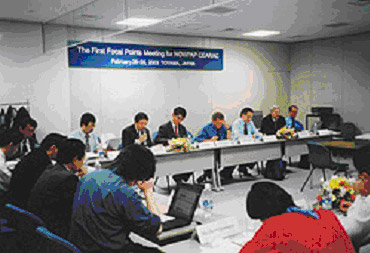
The NPEC (Northwest Pacific Region Environmental Cooperation Center) was designated as the CEARAC (Special Monitoring and Coastal Environmental Assessment Regional Activity Center) which is one of the four Regional Activity Centres (RACs) to coordinate activities relevant to specific components of the Action Plan for the Protection, Management and Development of the Marine and Coastal Environment of the Northwest Pacific Region (NOWPAP). The NOWPAP was adopted as one of action plans under the United Nations Environment Programme's (UNEP's) Regional Seas Programme. Four countries; Japan, the People's Republic of China, the Republic of Korea and the Russian Federation, participate the Programme. In order to discuss activities of CEARAC, the First CEARAC Focal Point Meeting (FPM) was held in Toyama, Japan in February 2003. It was agreed that “Remote Sensing the Marine Environment” and “Harmful Algal Bloom including Red Tides” should be taken up as priority issues for the “Special Monitoring activity” and the “Coastal Environmental Assessment Activity” respectively In the Meeting, the status reports by the participating countries and other organizations were presented, and then a heated discussion was held as to what activities CEARAC should engage in, in the future based on the above reports. It also selected the subjects which should be placed on the agenda at the Meeting of the Expert Working Groups on HAB/red tides and Remote Sensing to be held sometime between autumn and winter, 2003. Finally the CEARAC Work-plan for 2003 and the Terms of Reference for CEARAC FPM were adopted |
Date: February 25th (Tue)~27th (Thu), 2003 Venue: Conference room in Toyama International Center Participants: Focal Points from the People’sRepublic of China, the Republic of Korea, the Russian Federation and Japan, Representatives of UNEP, Experts of international organizations on marine environment, Directors of NOWPAP RACs (Total about 20) |
| Contents of the Meeting |
1 Opening of the Meeting Dr. Ellik Adler, Senior Programme Officer of Regional Seas Programme made an opening remarks on behalf of Dr. Klaus Töpfer, Executive Director of the UNEPA after an opening statement and Mr. Yutaka Nakaoki, Governor of Toyama Prefecture made a welcome speech.. 2 Presentation of the Status Reports by the NOWPAP countries and other international organizations Dr. Ellik Adler, Coordinator of the NOWPAP made a presentation on the progress and prospects concerning the activities of the NOWPAP. The representative of China (Mr. Zhang Jianhui, China National Environmental Monitoring Center) explained the status on HAB/red tides in the coastal area of the Yellow Sea and the application of remote sensing data by satellites to marine environment monitoring. He also reported that damages caused by HAB/red tides has rapidly increased in China since 1990. The representative of Korea (Dr. Choi Hee Gu, National Fisheries Research & Development Institute) reported that the damages brought to the fishery industry by HAB/red tides have become a great problem in Korea and that an ocean observation satellite of India, besides those of the United States, is used for the purpose of marine observation The representative of Russia (Dr. Leonid Mitnik, V.I. Il’ichev Pacific Oceanological Institute, Russian Academy of Sciences) stated that various oceanic phenomenon such as oil pollution, water temperature, difference in plankton concentration, convection of the atmosphere and water, movement of drift ice have been clarified through marine observation data obtained by the microwave sensor. He also introduced the “Rader Observation Project” by a cluster of small satellites which is now planned by Russia. .The representative of Japan (Dr. Yasuwo Fukuyo, the University of Tokyo) made a presentation on the status on the implementation of counter-measures against HAB/red tides based on his study and experience in Seto Inland Sea. Another representative, Dr. Ichio Asanuma (Earth Observation Research Center, National AeroSpace Development Agency of Japan), introduced Japan’s activities concerning marine observation by remote sensing, including the multi-purpose sensor on the satellite “ADEOS-Ⅱ” which was successfully launched in December, 2002 and the “Watch System of the Marine Environment in the Northwest Pacific Region” installed by the Ministry of the Environment at Kosugi, Toyama Prefecture. The representative of the North-East Asian regional component of the Global Ocean Observing System (NEAR-GOOS) of International Oceanic Commission (IOC), UNESCO, and both of an IOC expert in HAB/red tides and the Director of MAP/ERSRAC, one of the RACs of the Mediterranean Action Plan, reported on a current trend of joint researches in the region and the status of related activities, respectively. 3 Adoption of the Terms of Reference for CEARAC/FPM The Meeting discussed and adopted the draft Terms of Reference (TOR) which defines its objectives, tasks and rules of procedures for the Focal Point Meeting with some revision. 4 Review of Requirements and Work to be implemented for Working Groups In order to study the subjects to put on the agenda of the First Meetings of two above-mentioned Working Groups scheduled to be held separately sometime between this autumn and winter, the FPM discussed them after dividing the Meeting into two groups: the group for HAB/red tides and the group for Remote Sensing the Marine Environment. As to HAB/red tides, the standardization of monitoring method, and training and technology transfer required for it are selected as the subjects of the WG Meeting. As to Remote Sensing, the Meeting, in the hope of putting them to practical application, picked up two subjects as the agenda items - determining the problems which are urgently reqired to be resolved and finding out their solutions which are technically possible concerning eutrophication and oil pollution. 5 Adoption of CEARAC 2003 Workplan The Workplan and budget (about 15million Yen) for CEARAC in 2003 was reviewed and approved. It includes organization of WGs meeting and various research and studies for the WGs. Some comments were made on the framework plan of work for 2004/2005 which was presented at the Meeting. 6 Other Matters The NPEC introduced their survey on washed-up driftage along the coast in Northwest Pacific Region. It has been conducted for 7 years in cooperation with Toyama Prefecture. The representative of the UNEP commented that the issue of marine litter is of major concern to the marine and coastal environment and that the NOWPAP should deal with this problem in the future. 7 Adoption of the Meeting Report and Closure of the Meeting A draft report of the 3-day-meeting was adopted and the Chairman declared the Meeting closed. |
|
○ Advisory Committee on HAB/Red Tides
and Research and Study Committee on
Remote Sensing Held in Tokyo |
To provide CEARAC feasible advice on “HAB/red tides” and “Remote Sensing” that are considered as immediate priority issues for the NOWPAP, the NPEC has established the Advisory Committee on HAB/red tides (ACOH) and the Research and Study Committee on Remote Sensing (RCRS), both of which consist of experts in this country. Prior to the First CEARAC Focal Point Meeting (FPM), the ACOH was held in January, 2003 to study the contents of the status report for the FPM on HAB/red tides in Japan and discuss how to proceed with the Meeting. After the FPM, the joint meeting between ACOH and RCRS was held in April, 2003 to discuss the future activities based on the report of the First FPM.
|
| ○ Members of Advisory Committee on HAB/red tides |
|
Name |
Organization/Title |
|
Joji ISHIZAKA |
Professor, Faculty of Fisheries, Nagasaki University |
|
Ichiro IMAI |
Associate Professor, Conservation of Coastal Ecosystems, Hall of Global Environmental Research / Department of Natural Resources, Graduate School of Global Environmental Studies |
|
Satoru, TODA |
Division Chief, National Research Institute of Fisheries and Environment of Inland Sea, Fisheries Research Agency |
|
Yasuwo FUKUYO (Chairman) |
Professor, Asian Natural Environmental Science Center, The University of Tokyo |
|
Ken FURUYA |
Professor, Aquatic Bioscience, Graduate school of Agricultural and Life Science, the University of Tokyo |
|
Osamu MATSUDA |
Honorary Professor, Hiroshima University |
|
Tetsuo YANAGI |
Professor, Research Institute for Applied Mechanics, Kyushu University |
| ○ Members of Research and Study Committee on Remote Sensing |
|
Name |
Organization/Title |
|
Ichio Aasanuma |
Researcher, Frontier Research Promotion Department, YOKOHAMA Institute for Earth Sciences, Japan Marine Science and Technology Center |
|
Joji ISHIZAKA (Chairman) |
Professor, Faculty of Fisheries, Nagasaki University |
|
Hiroshi KAWAMURA |
Professor, Center for Atmospheric and Oceanic Studies, Graduate School of Science Tohoku University |
|
Toshiro SAINO |
Professor, Hydrospheric Atmospheric Research Center, Nagoya University |
|
Takashi MORIYAMA |
General Manager, Department of Application and Service, Remote Sensing Technology Center of Japan |
|
Yoshifumi YASUOKA |
Professor, Institute of Industrial Science, University of Tokyo |
|
Tetsuo YANAGI |
Professor, Research Institute for Applied Mechanics, Kyushu University |
|
Jong-Hwan YOON |
Professor, Research Institute for Applied Mechanics, Kyushu University |
| (As of August, 2003) |
 back to menu |