R@2002 Survey Washed-up Driftage along the Coasts in Northwest Pacific Region (Report)

P Objective of the survey

  The objective of the survey is to provide related countries with a reference material for their designing protection measures for the marine environment and fishing grounds and waste disposal in Northwest Pacific region by grasping the actual status of washed-up driftage and buried objects along the coasts of the region. The survey also aims at raising awareness of residents in the region toward the importance of the protection from waste of the marine environment.

2@Outline of the survey


The survey has been conducted since 1996 with the cooperation of local entities of Northwest Pacific region. It consists of two parts ? the surveys on washed-up driftage and buried objects.

1) Areas of the survey
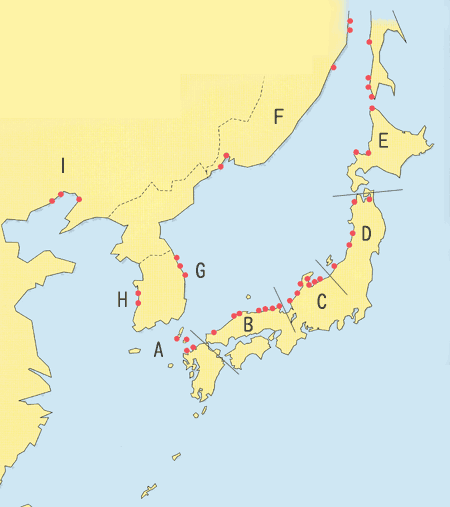
The survey of washed-up driftage was conducted on 43 beaches along the Sea of Japan and Yellow Seas in local entities of the four countries ? Japan, Russia, Korea and China ( figure 1 ), while that of buried objects was carried out on 17 beaches of the survey areas of washed-up driftage in Japan, Korea and Russia.

2) Period of the survey
The survey was conducted between August and October of 2002.

3) Method of the survey
E Washed-up driftage
All the washed-up driftage is collected in each survey section which is a square with sides of 10 meters and classified into 8 categories including plastics and glass/pottery. Its number and weight are counted and weighed by category.
EBuried objects
The sand within each buried frame which is 40 cm long, 40 cm wide and 5cm deep is put into a bucket and stirred with some sea water and the floated objects are scooped with a net. Thus collected samples are counted and weighed by category.

4) Number of the Participants
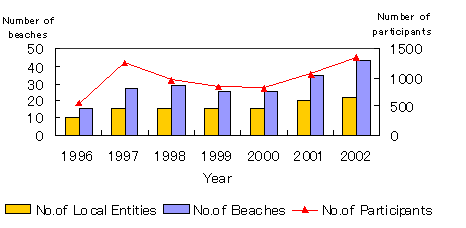
Participants ranged from staff of municipalities to so-called eco-clubs, etc. within related provinces and states. The number of participating parties was 13 while the total number of participants was 1,346. The participating municipalities, survey areas and total participants has increased annually in number in recent years ( figure 2 ).


Figure 2 Numbers of Participating Local Entities & Participants


3 Findings of the survey


1) Washed-up driftage
Area A had the biggest average number of washed-up driftage, 19 times that of area E which showed ith the smallest average number (figure 3). It was found that there was a tendency of decreasing in number as going up north.

By area and category the ration of plastics was highest in area A to E and G, reaching 68.6 to 86.0 per cent. In area F plastics had the highest ratio of 52.8 per cent followed by glass/pottery which accounted for 33.5 per cent. On the other hand, in area H plastics, glass/pottery and metal were detected in order of the number ratio, all the categories being on the level of 10 per cent and other artificial articles including wood accounted for 30 per cent. It is considered that this reflected the modes of life and consumption patterns of each district.
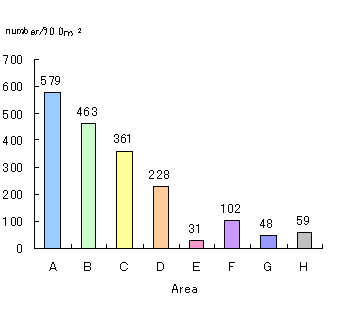

Figure 3 Number of Washed-up Driftage per beach

2) Buried objects
As a result of classifying the collected into 13 categories, it was found that Styrene foam was the highest ratio of 90.9 per cent followed by plastic product splinters and raw material, their ratios being 7.2 per cent and 1.1 per cent respectively.


back to menu